
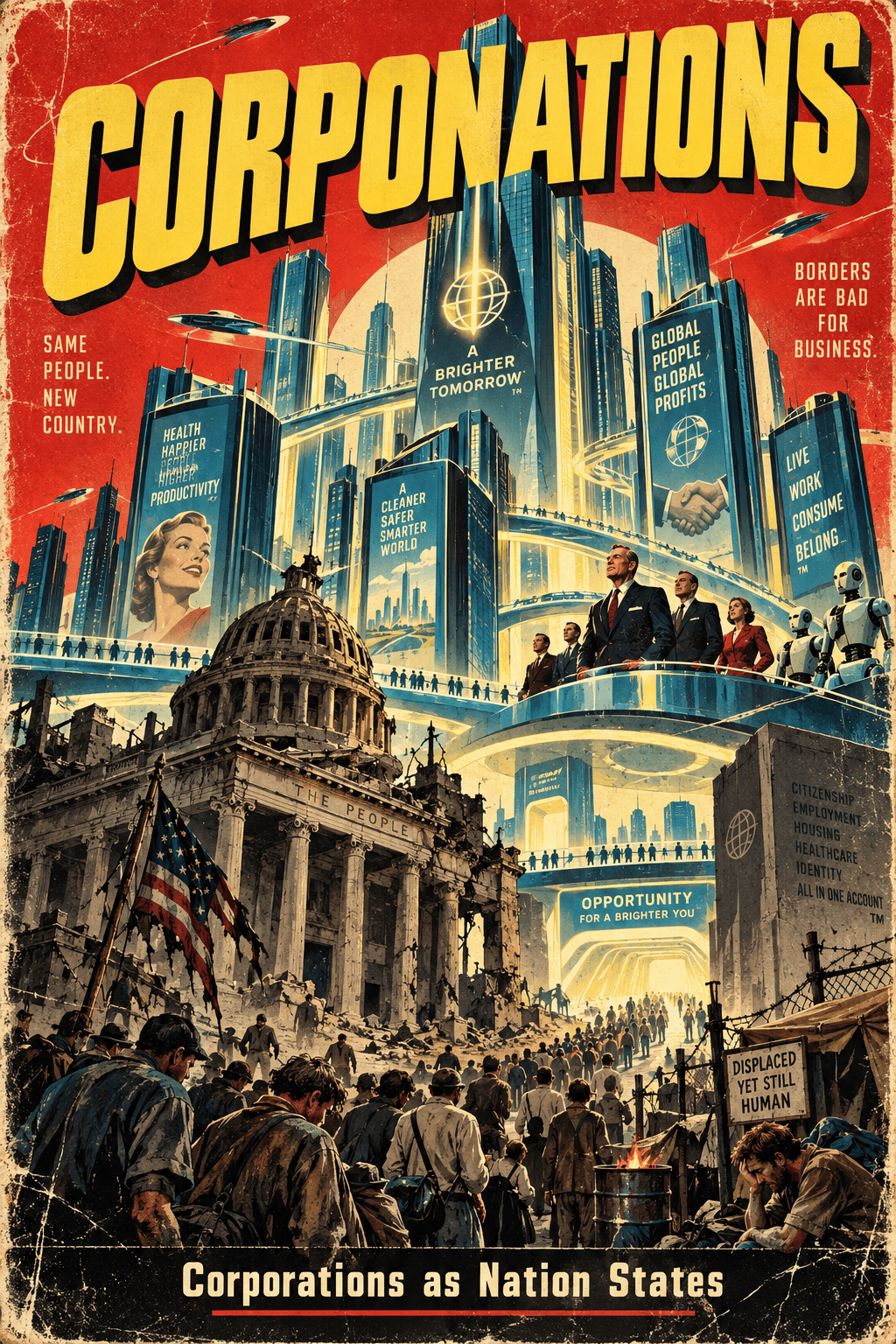
Would Corporations Replace Nation States?
In October, 2026, Anthropic announced that it would allocate 5% of its shares, subject to shareholder approval, to a newly established Public Benefit Fund. The fund could grow further as Anthropic’s valuation increases, potentially financing charitable organizations, direct payments to selected populations, and programs addressing the economic disruption caused by AI.
Basically, corporate-based Universal Basic Income (UBI). Well, of sorts.
Where economists and politicians failed to deliver, the private sector has picked up the glove and taken center stage. No longer in the shadows, buying its way to power and setting the agenda through lobbyists, corporations now eye state-level functionality, hollowing out old structures.
And Anthropic is but an early bird.
AI Autocracy
AI companies like OpenAI, Anthropic, Google, and Microsoft control the AI sector, alongside infrastructure companies selling the shovels and denim needed to make AI happen, like Nvidia. Those companies, whose CEOs are often seen mingling with presidents and world leaders, have formed a small, closed club that calls the shots.

The same few corporations that build the frontier AI models we use daily also own the data centers, hardware, and troves of training data nobody else has. Models that power our lives much like electricity powers our household. If AI models shut down, most of the tech world, as well as many other sectors, would grind to a halt.
This is no longer reversible.
Past platforms such as Stack Overflow, Getty Images, and many others that were once go-to platforms for programmers and content creators were decimated as models took over what they had carefully curated for years upon years (ironically, trained on that same exact data). Cheaper, faster AI agents won multiple jobs once done by humans, sending employees into unemployment.
Nation-states are slow to grasp the magnitude of this tsunami, led by incompetent populists who talk and do nothing. Politicians who barely adapted to the Internet and Social Media are overwhelmed by AI’s lightning-fast progress, lagging behind a rapidly changing reality, letting down a newly created lower class of once-useful employees who are sent home with no apparent way to support themselves and their families.
But not everyone shares this grim view. Jeff Bezos, for one, is quite optimistic, envisioning the newly unemployed becoming entrepreneurs and using AI to create new products once deemed impossible for the layman. Elon Musk goes further, claiming robots will take over all professions and make human labor redundant. Isn’t it ironic? The same people who took all human-curated knowledge, produced by the people now made redundant, are preaching to those whose jobs they took how to make ends meet, while never paying for the work that enabled their current wealth.
One would expect legislation, past (e.g., copyright laws) or future, to correct those wrongs, to somehow propagate the wealth created by AI to those whose work has fed the machines. However, while many cases are still pending, courts are leaning toward fair-use resolutions in cases involving the use of copyrighted content for model training, leaving creators empty-handed. Photographers, artists, authors, and programmers are quickly left on the sidelines as AI models trained on data they once created do their work. Data centers feeding the ever-growing demand for compute are springing up like daisies in metropolitan areas, gobbling power at the expense of the original residents.
A brave new world is upon us.
AI czar Sam Altman openly says AI may create hazards beyond our control, but it’s an acceptable sacrifice when weighed against its benefits. Which is what you’d expect from someone whose wealth can buy a ticket to Elon Musk’s terraformed Mars in a SpaceX rocket should things go sideways. On the other side of the globe, Chinese companies are running amok building humanoid robots, which, combined with unharnessed AI models, will surely become autonomous military agents. An arms race if there ever was one, but a much more dangerous one, one that could spiral out of our control, socially, as well as existentially.
Social Bomb
The social contract on which modern democracies were built is rather simple. Citizens work, earn money, pay taxes, and expect their governments to provide security, infrastructure, education, and some protection against life’s misfortunes. The system was never particularly fair, but it worked well enough to keep most people from taking to the streets.
AI is breaking this contract.
Research from Stanford already points to a troubling decline in employment opportunities for young workers in AI-exposed professions. The first casualties may not be those who lose their jobs, but those who never get the opportunity to start one. And unemployment is about much more than lost income. Work gives people status, structure, purpose, and belonging. Take those away from millions, especially from an educated middle class raised to believe that hard work and education guarantee a decent living, and you are left with something far more volatile than an economic recession. You are left with millions of angry people with plenty of time on their hands.
Economic insecurity has already helped fuel the rise of populism across Western democracies. Research on European elections has demonstrated how economic insecurity drives voters toward populist parties while eroding trust in political institutions. Now imagine that insecurity multiplied by millions of displaced workers, watching their former employers report record profits while their governments explain that they simply need to adapt.
Who will they blame? The machines? The corporations? The politicians who allowed it to happen? History suggests that anger does not necessarily find its rightful target. Populist leaders have become remarkably skilled at redirecting economic frustration toward immigrants, minorities, foreign countries, and imaginary enemies.
Fragile democracies, already struggling with polarization, misinformation, and declining institutional trust, may find themselves unable to withstand the pressure. Some governments will turn increasingly authoritarian, using AI-powered surveillance and policing to contain the very unrest AI helped create. Others may collapse into political paralysis, unable to tax the corporations responsible for the disruption, who had become “too big to fall”, or provide meaningful alternatives to their citizens.
The real danger, therefore, is not merely mass unemployment. It is a crisis of legitimacy. What exactly is a government for if it cannot guarantee its citizens a reasonable chance to make a living? Why should citizens remain loyal to institutions that offer them little more than patriotic speeches and increasingly expensive elections?
The social bomb is ticking. And the people who understand its mechanism best are not sitting in parliaments.
They are sitting in boardrooms.
Corponations
Anthropic’s move follows an earlier commitment of $200 million to researching the economic consequences of AI, including unconditional income experiments, worker compensation, and mechanisms for redistributing AI-generated wealth.
This is not yet UBI, nor is it a legally enforceable promise to support the unemployed. But it is something potentially more significant: a corporation beginning to assume responsibilities traditionally reserved for nation-states. Should we applaud Anthropic’s generosity? Perhaps. But attributing this development merely to the goodness of its executives’ hearts would be rather naive.
Anthropic understands something that governments have been painfully slow to grasp: an economy in which corporations generate enormous wealth while millions of people are rendered economically redundant is not sustainable. Not politically, not socially, and eventually not even commercially.
After all, what good is producing everything at almost zero cost if nobody has the money to buy it? That is, if money survives this transition at all. And what good is becoming the wealthiest corporation in human history if the society surrounding you is tearing itself apart?
What Anthropic is doing can therefore be understood as preventive maintenance. By financing research into unemployment, experimenting with wealth redistribution, and presenting itself as a responsible guardian of AI development, it is attempting to reduce the social and political pressures that might otherwise lead to severe regulation, punitive taxation, or demands to halt AI development altogether (this does not mean its executives are insincere about the public good. It means that, for once, doing good and protecting corporate interests may be remarkably well aligned).
Sound familiar? That is exactly what was once deemed the role of nation-states.
And Anthropic is hardly alone. OpenAI has already established a foundation holding a substantial equity stake in its commercial operations, with commitments to fund public-benefit initiatives. Other AI corporations have every incentive to develop similar mechanisms. Not necessarily because they have suddenly discovered social justice, but because social stability is becoming an increasingly important business requirement.
This is where things become interesting.
Consider Google. Its employees, known as Googlers, have long inhabited something resembling a miniature nation. They share an identity, a vocabulary, an internal culture, a set of values, elaborate benefits, and an extensive ecosystem of services and infrastructure. Their allegiance is not geographical. A Googler in California, London, or Singapore may have more in common, professionally and culturally, with another Googler across the ocean than with the people living next door.
Google has its own institutions, rules of conduct, hierarchy, welfare mechanisms, and even a founding mythology. Other technology giants have developed similar cultures, complete with corporate identities that extend far beyond ordinary employment.
These are not nation-states, of course. They cannot issue passports, levy general taxes, or legitimately exercise the sovereign powers of a government. But they demonstrate how a corporation can cultivate something resembling national identity without territory, nationality, or democratic institutions.
Now extend that model beyond employees.
Imagine an AI corporation that provides you with the tools to work, the education needed to use those tools, healthcare assistance, access to information, financial services, and eventually a basic income when your labor is no longer needed. Your daily existence becomes increasingly dependent on an ecosystem owned and governed by a corporation whose operations span the globe.
Why would your geographical nationality matter as much as your membership in that ecosystem?
And here we are, in the age of Corponations.
These new entities would have no need for national borders. Their citizens would be users, employees, developers, and beneficiaries, connected by digital infrastructure rather than geography. Boards of directors would set their economic policies, their constitutions would be written in terms of service, their welfare programs would be financed by corporate profits, and their laws would be enforced through access to platforms, services, and money.
Unlike traditional governments, their rulers would not need to stand for election. You could theoretically leave one Corponation and join another, provided an alternative existed and you could afford to abandon the ecosystem on which your livelihood depended. Corporate citizenship would be “voluntary”, much like having a bank account, a smartphone, or access to the Internet today.
Of course, nation-states would not simply disappear. They would retain their flags, armies, police forces, parliaments, and bureaucracies. They would continue collecting taxes, enforcing laws, and organizing elections. But their practical relevance to citizens’ everyday lives would gradually diminish.
Politicians would continue arguing over borders, immigration, religion, and national identity, while corporations increasingly determined how people work, learn, communicate, and survive. Nation-states would become hollow shells, maintaining the appearance of sovereignty while the essential functions that once justified their existence migrate elsewhere.
This arrangement poses a profound danger. A democratic government, however dysfunctional, is at least theoretically accountable to its citizens. A corporation is accountable primarily through its own governance structure, commercial incentives, and whatever obligations the law imposes upon it – laws created by politicians that would come ever more dependent on corporate funding. Its generosity is discretionary. Its rules can change. Its benefits can be withdrawn.
A citizen has rights. An employee has a contract. And a beneficiary has to hope that the benefactor remains benevolent.
Perhaps the greatest irony is that UBI, originally conceived as a way to free people from economic dependency, could become the very mechanism that establishes an unprecedented form of dependency. Not dependency on the state, but on the handful of corporations that own the machines.
The nation-state was built around the idea that people sharing a territory should govern themselves. The Corponation would be built around a rather different principle: those who control the technology that sustains society may eventually control society itself.
And this time, they might not even need to buy the politicians.
Science fiction, many times prophetic, has long anticipated this development. As early as 1953, Frederik Pohl and C. M. Kornbluth’s The Space Merchants envisioned governments reduced to serving enormous corporations. William Gibson’s Neuromancer placed multinational conglomerates above the declining nation-state, while Neal Stephenson’s Snow Crash imagined sovereign corporate franchises replacing the United States. Stephenson took the idea further in The Diamond Age, replacing geographical nationalities with trans-national phyles, communities sharing values, economic interests, and a common identity. The more recent Max Barry’s Jennifer Government went so far as to have people adopt their employers’ names, making corporate allegiance their defining identity.
What these authors envisioned as dystopian satire is beginning to resemble a plausible near-future political rearrangement. The only difference is that science-fiction corporations conquered the notion of a state. Those of the twenty-first century may simply render it obsolete.
Final Thoughts
I suspect the first genuine corporate UBI programs, if they materialize, will be presented as temporary remedies for AI-driven unemployment. They may initially target specific communities, professions, or geographical regions. Other AI corporations will follow, partly out of social responsibility, partly out of competitive necessity, and partly because keeping society from collapsing is generally good for business. Eventually, such programs could become permanent, expanding into entire ecosystems of corporate welfare.
And then comes the interesting question: who qualifies?
Will Google’s UBI be available to everyone, or only to those participating in its ecosystem? Will Anthropic’s beneficiaries enjoy the same advantages as OpenAI’s? Will people be free to move between them, taking their benefits along, or will corporate membership become another form of economic captivity? And what about those who are not part of those corponations?
The next generation may face a choice their parents never imagined: not merely which country to live in, but which corporation to belong to.
Another future is, of course, possible. Governments could wake up, tax the extraordinary wealth AI generates, establish publicly administered income guarantees, enforce competition, and ensure that the infrastructure of intelligence remains subject to democratic oversight. AI could provide humanity with an unprecedented opportunity to liberate itself from the economic necessity of work, rather than replacing one kind of servitude with another.
But that would require politicians who understand the problem, institutions capable of acting at the speed of technological change, and voters willing to look beyond the manufactured outrage of the week. None of which is particularly abundant these days.
The question is no longer whether AI will profoundly alter the relationship between labor, capital, and the state. It already has. The question is who will inherit the political power that comes with controlling the means of intelligence, and whether democratic institutions will retain any meaningful authority over it.
The Industrial Revolution concentrated ownership of machines while leaving human labor indispensable. The AI revolution threatens to concentrate ownership of the machines while making human labor increasingly dispensable. It is a rather unfortunate combination, especially for the humans.
Perhaps Anthropic’s initiative is genuinely the beginning of a more responsible form of capitalism. Perhaps other corporations will follow, and a new social contract will emerge in which the immense wealth produced by artificial intelligence supports people who no longer need to work.
Or perhaps we are witnessing the birth of a new form of feudalism, one in which the lords own the intelligence, the peasants receive their monthly allowance, and the king continues to wave from his balcony, blissfully unaware that he no longer rules anything.
The future may be one of abundance. It may even be one of leisure, creativity, and unprecedented human freedom. But abundance is not the same as equality, and being provided for is not the same as being free.
The most consequential question of the AI age may not be whether machines will become more intelligent than humans, but whether humans will remain citizens or become beneficiaries.
* Corporations as nation-states, Corpo-Nations

