
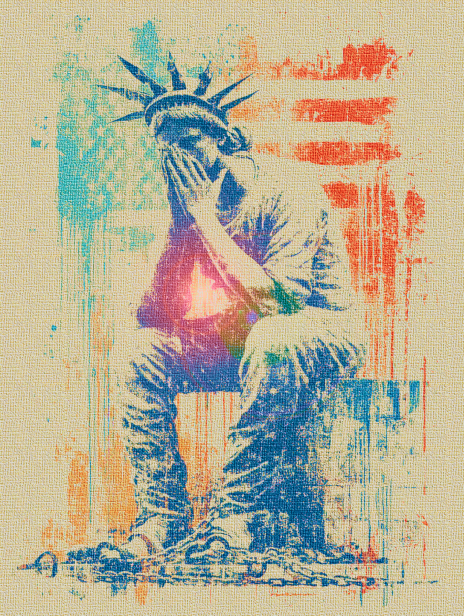
Have We No Shame?
Democracies are failing—not one or two, but many, and more to follow. From the US throughout Europe, a murky wave of semi-dictatorships and autocracies that carry the pretense of democracy has taken over. Once proud nations have fallen under the boot of populism.
In mid-2019, a moment before the Coronavirus broke out of Wuhan, I wrote Relative Meritocracy, where I claimed modern democracies would soon fall apart. Little did I know how quickly this dystopia would materialize.
The main argument was that any functional democracy is based on two assumptions: that people are rationally self-serving and sufficiently well informed to make decisions for the common good, both of which no longer hold.
Instead of one vote per person, regardless, I suggested we embrace a new system. One that considers the ability of the individual voter to make decisions on one hand, and replaces voting for a political party with voting for a set of agendas. As you can imagine, people were adamant in responding. The system was based on Quadratic Voting combined with a personalized decision tokens quota allocated according to one’s history of rational decision making.
But that ship has sailed.
Current democracies can not and will not become multi-vote decision-making meritocracies. It’s too complex and too controversial. Even if we had tried this, people have become too lazy to work in their own self-interest. It’s like Internet forms. No one ever fills those anymore, as they are considered cumbersome and require spending time. The age of soundbites, constant stress, doom scrolling, and AI bots has created a society that would rather copy the vote sheet from friends on social media or ask ChatGPT what to vote for. And it’s not just the feeble-minded.
My late father always complained about doctors. “They always give me options”, he used to grumble, “why can’t they simply tell me what to do? They are doctors for heaven’s sake!”. In some ways, we are all like that. We simply want someone to tell us the right thing to do, what is the best career move, what is the best way to lose weight, and how to live our lives such that we don’t have to wade through all those options.
Into that chasm of lazy-minded, uninformed minions, a monster crawled. A truth-eating hydra that feeds on lies and deception. Its heads are many, but all work in concert. Be those corrupt politicians, broligarchs wielding their social networks, conspirators, and scammers. All share a common goal, namely, to undermine reality and navigate it to their own interests, none of which fly well with the idea of democracy, you know, that old thing, to serve the people.
Can we fight back?
Emotions. Weaponized.
If we ever want to “restore balance to the Force“, we must accept the fact that the failure of the current democratic system is rooted in emotional, rather than rational, voting and work within that premise.
We must use emotions to fight emotions, but before we do that, we need to understand why. Why have emotions taken center stage, outdoing all other forms of human thinking? Or in less polite terms, who do we blame this on?
The short answer is: our lizard brains, the far-right, and the far-left.
As we currently cannot do anything about our lizard brain, let’s focus on the other two. The far right has always relied on emotional responses to real, as well as imaginary threats, as a basis for driving its voters. Only in recent years has the far left foolishly joined forces with its nemesis. The Woke movement has brought emotions onto center stage, relying on those for just about anything. No more truth; it’s how you feel that sets reality. In that sense, the right and the left have made a pact wrought hell. One that would have, and actually is, destroying any chance of rational thought. From conspiracy theorists on the far right to people who identify as cats, the truth has been put down like a rabid dog. And the age of voting against has been ushered in.
Once emotional responses, amplified by social networks (often on purpose), are setting the tone, it’s easy to herd voters to the booth to vote for someone simply because you hate his opponent more than you like him. This was true for Donald Trump during his first term, and more so in his second one. It is true in Israel, as many voters are casting votes for people they know are unfit, working against their self-interest, just because they were taught to hate the other party. And the same goes for Hungary and other shallow democracies rapidly turning into de facto dictatorships.
Can we repurpose emotional response as a counter-weapon?
“It is necessary to win over the hearts of the masses, and all means are permissible. It is important to speak in as primitive a language as possible, because these people think in a primitive way […] Since the ground is not yet ripe for physical violence, we must, for the time being, resort to spiritual violence. Use the scarecrow of intimidation effectively: […] bleeding-hearts; frustrated leftists; afraid of what the Gentiles will say; aiding the enemy; subverters of Israel […] A certain moment will arrive when we must shift from telephone threats and warning letters—to action. To impose censorship on radio, on television, and on books, plays, and films. To root out the press from its nests of defeatists and enemy agents. To infiltrate the judiciary. To begin intensive indoctrination within the IDF. To cultivate political officers. We must turn the outposts in the [Gaza] Strip into re-education camps for crushing traitors. We need to shake and jolt this passive people, to provoke polarization and hatred. The best gift from God to us is the hatred of our opponents; to them we shall return this hatred with all our hearts. And then, this entire rotten country will fall into our hands.”
Sylvie Keshet, an Israeli Political Reporter, 1972
Hitting the Emotional Reset Button
A recent (2023) meta-analysis of guilt and shame studies identified both shared and distinct substrates for guilt and shame. Both consistently activate the left anterior insula, key for interoceptive awareness, while guilt specifically engages the left TPJ (temporoparietal junction), underscoring the role of social-cognitive processing in experiencing remorse and motivating reparative action.
These findings chime with what has been and still is a central part of many religions, namely Atonement.
Atonement physically modifies the structure of the brain in those areas responsible for moral decision-making. Over time, repeated cycles of shame – regulation – repair induce both functional and structural strengthening of brain networks taking part in moral conduct, effectively recalibrating moral thresholds so that inhibitions against wrongdoing remain robust. In layman’s terms, once you atone, you hit a neurological moral reset button, regaining moral inhibitions that were put into place to prevent you from going astray.
Not surprisingly, some of the brain areas involved in moral decision making (i.e., dorsolateral prefrontal cortex) are also employed in the processing of deception and lying.
Simply put, one lies, deceives, and behaves immorally. Then regret kicks in, dialing back his inhibitions for future deception, and he feels so much better.
We can work with that.
Shame
Shame has been long exiled. Social networks, politicians, broadcasting networks, and once fortresses of hard-core journalism have fallen under the boot of fake news, shameless see-through lies, and mass deception. No one is ashamed to be caught lying anymore, and nobody fears the backlash of immoral and deceptive behaviour. From the top, down to the mail room, faking it has become the norm.
If you want to win an election, simply throw as many lies and mud at your opponent. The lies would stick long enough to create a shift in public opinion, even if they are easily refuted. Cognitive confirmation bias would tighten the grip of those lies on voters, and the mass of them would create a mental fatigue so great that one cannot withstand the effort required to sift through them.
This technique of deceiving one’s way to power has been in play for the last decade, with increasingly effective results culminating in the last US election. Once you exile shame, once you pride in your ability to lie without any moral consequences, the minions align and copy. It is true for an organization as small as ten people, up to nation-scale. The character of the leader propagates down to the last individual, be it a company or a country. Once shame is stripped of its power to calibrate social behaviour, everything rapidly falls apart.
By now, I guess, you get where we’re getting at.
I’m Bringing Shameful Back
Surely you have seen people using shaming tactics. Only lately (2025), we have seen a massive shaming grassroots campaign against Elon Musk’s Tesla following his Nazi salute during a speech he gave. Tesla vehicles were defaced, and advertisements were placed in major cities calling them swastikars while Tesla’s stock plummeted.
It is true that shaming can be used both ways, and weaponizing it may have an ill effect on societal structures; however, that is both the double-edged sword risk in using any weapon, and moreover, and more importantly, we truly have no choice.
If we refuse to use shame as a defensive weapon, we are going to live under some kind of a shallow democracy or, better still, semi-dictatorship (if we are lucky). Avoiding this sad state of affairs, or at least minimizing the duration we have to spend under the boot, requires drastic measures, even if it could be later misused.
It is apparent that to save the liberal democratic way of life and its systems, we must bring shame back. This seemingly minute change would have a butterfly effect on the entire (currently corrupt and falling apart) ecosystem.
Once the people regain the feeling of shame, they will look upon their leaders differently. Those who cheat and lie their way to office will no longer be considered political wizards, rather cons. Acts of treachery and bluffing would be outcast rather than embraced and celebrated with a wink and a nudge. Upward propagation should be swift, as voters’ role models are replaced by those to whom shame and morality apply.
In a way, should we succeed in weaponizing shame against those who misused our emotional responses, we would be able to recalibrate the entire social structure back to where the moral parts of our brains, which have evolved for eons to sustain a stable society, were meant to bring us to.
But how?
The answer is both simple and complex. It’s up to us. And I mean each and every one of us.
As the saying (wrongfully attributed to Gandhi) goes: “Be the change you want to see in the world” (see the actual, much deeper, quote below).
Should each and every one of us make the decision to recalibrate his or her moral compass back to shame as a driving factor, we would create a tidal wave so strong, so swift, that no deceitful politician, broligarch, or any other force (once) to be reckoned with can withstand. Such a grassroots movement would shake the foundations of states, social networks, industry, and economics. When liars’ pants catch fire, a morality-based natural selection would kick in, sweeping everything and everyone. We can do that; it would be a shame to miss the opportunity.
“We but mirror the world. All the tendencies present in the outer world are to be found in the world of our body. If we could change ourselves, the tendencies in the world would also change. As a man changes his own nature, so does the attitude of the world change towards him. This is the divine mystery supreme. A wonderful thing it is and the source of our happiness. We need not wait to see what others do.”
Mahatma Gandhi, Originally published in Indian Opinion, August 9, 1913, and reprinted in: The Collected Works of Mahatma Gandhi, vol. 13, chapter 153, page 241.
 A Colder Lazarus